Branding, web and SEO agencies
Teams responsible for delivering a rebrand or website migration.
ZERO-TO-ONE B2B PRODUCT · 2026
Helping agencies catch rebrand mistakes before clients do.
RebrandCheck is a brand-migration QA product that helps agencies uncover legacy brand references, outdated domains, old contact details and migration leftovers before final client handoff.
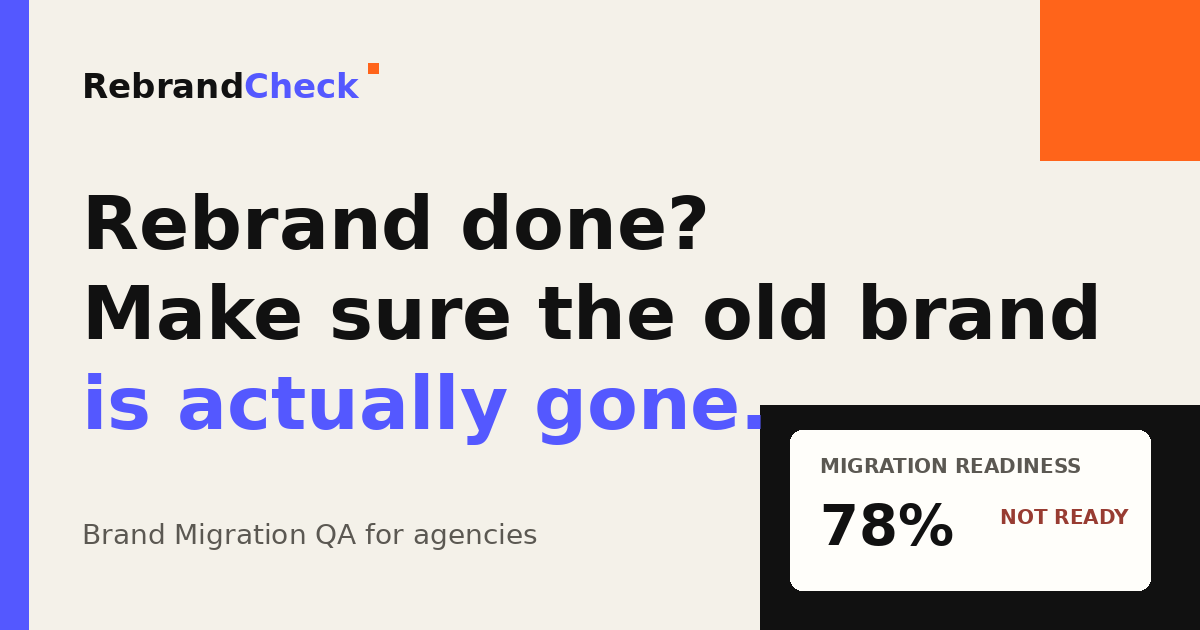
A new identity may already be live while traces of the previous brand remain hidden across legal pages, domains, email identities, metadata, canonicals, structured data and migration files.
The visible rebrand may be complete. The migration may not be.
The research focused on three questions: who owns the problem, when it becomes most expensive, and why existing site-audit tools do not fully address it.
Teams responsible for delivering a rebrand or website migration.
The point where a small leftover can create disproportionate doubt.
Most crawlers optimize for technical health, not identity residue.
A crawler tells you whether the website works. RebrandCheck asks whether the old identity is actually gone.
I translated the problem into a four-part model: define what changed, inspect where the old identity can survive, structure each finding, and convert the result into a deliverable.
Old brand
New brand
Old domain
New domain
Old email identity
Known leftovers
Brand references
Domains & links
Contact information
Metadata
Canonicals
Structured data
Sitemap
Severity
Location
Detected value
Expected state
Evidence
Recommended action
Executive summary
Prioritized findings
Evidence
Fix direction
Verification report
Landing · Audit intake · Sample report · Internal builder · Manual delivery · Direct agency outreach
The first product decision was what not to build.
Brand names, domains, email identities and known migration context.
Pages, links, metadata, canonicals, schema and sitemap.
Findings, evidence, expected state, actions and a verification report.
A portfolio simulation of the product interaction using fictional sample data.
A simple “legacy brand found” alert creates another investigation task. Each finding answers six questions immediately: severity, location, detected value, expected state, evidence and recommended action.
/privacy“…services provided by Northstar Inc…”
Confirm the correct legal entity and replace the legacy reference before final handoff.
The report had to help designers, developers, project managers and clients understand what remained, what mattered most and what should be fixed.
/privacyCRITICAL/supportCRITICAL/CRITICALSeverity creates a clear order of attention.
The report keeps the underlying proof attached to the issue.
The target value reduces ambiguity during implementation.
Recommended steps turn diagnosis into execution.
I used an AI-assisted development workflow to turn the product model and interface system into a working validation MVP. AI accelerated implementation while product structure, interaction decisions, visual system and QA remained design-owned.
AI was implementation leverage, not a substitute for product decisions.
The validation MVP was reviewed as an end-to-end experience rather than only a set of interfaces.
11 / VALIDATION
The MVP is live. The next phase is deliberately manual: reaching out to agencies, running early audits and observing which findings they value enough to act on.
The next question is not whether the product can be built. It is whether agencies care enough to use it repeatedly.MARKET VALIDATION IN PROGRESS
The strongest value may not be detection alone. It may be making migration completion visible, explainable and provable.
Automate only the checks that repeatedly prove useful during real agency audits.
Usage frequency, willingness to pay and whether agencies prefer per-audit delivery or an ongoing workspace.
Build less. Learn faster. Automate what earns the right to exist.